
Understanding Financial Statements (For Absolute Beginners)
 Hook – Read This Before You Buy Any Stock
 Hook – Read This Before You Buy Any Stock
Understanding financial statements : Most beginners jump into the stock market by checking share price, news, and maybe a few YouTube videos.
Very few actually look at the numbers behind the company.
But the truth is simple:
If you can read basic financial statements, you’ll immediately be ahead of most retail investors.
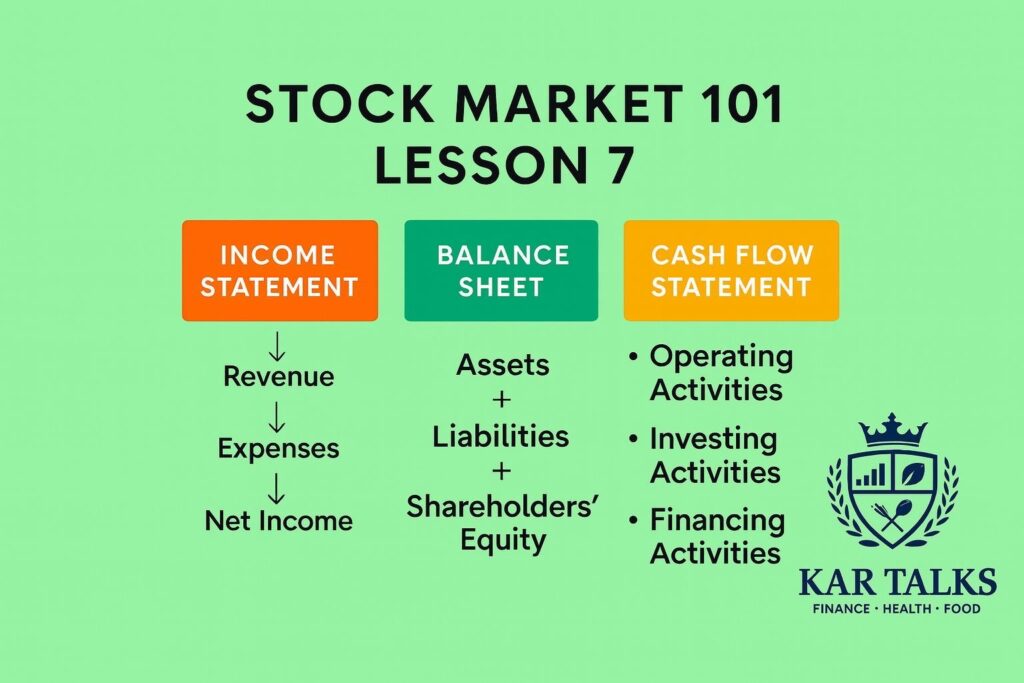
In this Stock Market 101 – Lesson 7, we’ll slowly and clearly walk through Income Statement Basics, Balance Sheet Explained, and the Cash Flow Statement in a way any beginner can understand. No heavy accounting. No formulas. Just simple, practical explanations.
This lesson is part of our Financial Statements for Beginners series and is designed to build your confidence step by step.
Understanding Financial Statements – What You’ll Learn in Lesson 7
 Understanding Financial Statements – What You’ll Learn in Lesson 7
By the end of this lesson, you’ll be able to:
- Understand Income Statement Basics – revenue, expenses, and profit
- See the Balance Sheet Explained in a simple way – assets, liabilities, equity
- Read a Cash Flow Statement and know why cash is different from profit
- Connect all three to understand company fundamentals
- Use this knowledge as a strong base for investing for beginners
- Take one more step forward in your journey to learn stock market concepts properly
Why Financial Statements Matter for Beginners
 Why Financial Statements Matter for Beginners
When you buy a stock, you’re not just buying a ticker symbol.
You’re buying a business.
To judge a business, you need more than price charts. You need to know:
- Is the company making real money?
- Is it drowning in debt?
- Is it generating cash, or just showing profits on paper?
That’s where financial statements for beginners come into play. You don’t need to become a CA or CFA. You just need to understand the basics of three documents:
- Income Statement
- Balance Sheet
- Cash Flow Statement
These three together give you a picture of company fundamentals. If you want to learn stock market in a serious, long-term way, these are non-negotiable.
Income Statement Basics – Is the Company Profitable?
 Income Statement Basics – Is the Company Profitable?
Let’s start with the Income Statement.
Think of it as a movie of how much the company earned and spent over a specific period (like a quarter or a year).
What the Income Statement Shows
 What the Income Statement Shows
In simple terms:
Income Statement = Revenue – Expenses = Profit
Key parts in Income Statement Basics:
- Revenue (Sales):
Total money the company earned by selling its products or services.
- Revenue (Sales):
- Expenses:
Money spent on salaries, rent, electricity, marketing, raw materials, etc.
- Expenses:
- Operating Profit:
Profit from the core business, before interest and taxes.
- Operating Profit:
- Net Profit:
Final profit after interest, taxes, and other income/expenses.
- Net Profit:
Small Example
 Small Example
Imagine a company:
- Revenue = ₹100 crore
- Total Expenses = ₹70 crore
- Net Profit = ₹20 crore
This looks good. Now, check a few years:
- Year 1: Net Profit = ₹10 crore
- Year 2: Net Profit = ₹15 crore
- Year 3: Net Profit = ₹20 crore
Profit is rising → good sign.
But this is only the first layer of company fundamentals.
Balance Sheet Explained – What the Company Owns and Owes
 Balance Sheet Explained – What the Company Owns and Owes
Now let’s get the Balance Sheet Explained in simple language.
While the income statement is like a movie, the balance sheet is like a photo.
It shows the company’s financial position on a specific date.
Balance Sheet Formula
Assets = Liabilities + Shareholder Equity
Key Components
 Key Components
- Assets (What the company owns):
Cash, buildings, machinery, inventory, receivables, investments, etc.
- Assets (What the company owns):
- Liabilities (What the company owes):
Loans, interest payable, supplier dues, tax liabilities, etc.
- Liabilities (What the company owes):
- Shareholder Equity (Owners’ share):
What belongs to shareholders after paying all liabilities.
- Shareholder Equity (Owners’ share):
Why This Matters for Investors
 Why This Matters for Investors
Even if a company looks profitable in the income statement, the balance sheet might show a different story:
- High debt
- Low cash
- Huge short-term obligations
For investing for beginners, one simple rule:
Avoid companies with very high debt compared to equity, especially if profits are not stable.
This is why the Balance Sheet Explained is crucial in any serious attempt to learn stock market analysis.
Cash Flow Statement – Where Is the Real Cash?
 Cash Flow Statement – Where Is the Real Cash?
Here’s the part most beginners completely ignore: the Cash Flow Statement.
A company can show profit but still struggle to pay salaries or suppliers. How? Because profit is an accounting number, but cash flow shows actual movement of money.
Three Sections of the Cash Flow Statement
- Operating Cash Flow
Cash generated from the core business (this is the most important).
- Operating Cash Flow
- Investing Cash Flow
Cash spent on or received from buying/selling assets, plants, equipment, or investments.
- Investing Cash Flow
- Financing Cash Flow
Cash from loans, issuing shares, paying dividends, or repaying debt.
- Financing Cash Flow
Why It’s Critical
For company fundamentals, the Cash Flow Statement tells you:
- Is the business self-sustaining?
- Is the company borrowing just to survive?
- Are profits converting into real cash?
A simple thumb rule for investing for beginners:
Long term, you want companies with positive operating cash flow consistently.
How the Three Statements Work Together
 How the Three Statements Work Together
To truly understand financial statements for beginners, you must see how all three are connected.
You can think of it like this:
- Income Statement → Tells you how much profit was made.
- Balance Sheet → Shows where that profit is stored as assets or retained earnings.
- Cash Flow Statement → Shows how much of that profit actually turned into cash.
Example:
- A company shows ₹20 crore net profit (Income Statement).
- Balance Sheet shows increasing assets and maybe some debt reduction.
- Cash Flow Statement shows positive operating cash flow of ₹18 crore.
This is healthy: profit is real, cash is flowing in, debt may be coming down.
That’s strong company fundamentals.
Simple 5-Step Framework for Beginners
 Simple 5-Step Framework for Beginners
Here’s a simple reading framework you can use every time:
Step 1: Check Revenue Trend (Income Statement Basics)
 Step 1: Check Revenue Trend (Income Statement Basics)
Is revenue growing steadily over multiple years?
Step 2: Check Net Profit
Is net profit rising? Are profit margins stable or improving?
Step 3: Look at Debt (Balance Sheet Explained)
Is debt manageable? Is debt-to-equity at a reasonable level for that industry?
Step 4: Check Operating Cash Flow (Cash Flow Statement)
Is the company generating positive cash from operations regularly?
Step 5: Compare Profit vs Cash
Are profits backed by cash flows?
If profit is rising but cash flow is falling, be careful.
This 5-step method is very useful for investing for beginners who want a structured way to review companies.
Common Mistakes Beginners Make
 Common Mistakes Beginners Make
When people learn stock market concepts only through price charts or tips, they often:
- Look only at revenue, ignore debt
- Get impressed by “big assets” but miss high liabilities
- Focus only on net profit, not on cash flow
- Ignore the Cash Flow Statement completely
- Don’t check if the company is borrowing just to survive
By understanding Income Statement Basics, having the Balance Sheet Explained clearly, and learning how to read a Cash Flow Statement, you avoid these traps.
Key Takeaways from Lesson 7
 Key Takeaways from Lesson 7
Let’s quickly recap:
- Income Statement Basics tell you if the company is profitable.
- With the Balance Sheet Explained, you can see assets, liabilities, and true financial strength.
- The Cash Flow Statement reveals if profits are backed by real cash.
- Together, these three form the core of company fundamentals.
- This lesson is part of Financial Statements for Beginners, built specially for investing for beginners.
- If you truly want to learn stock market in a serious way, financial statements are your best friends.
Final CTA – Your Next Step
 Final CTA – Your Next Step
You don’t need to become an expert overnight.
Start small:
- Pick one company you know
- Download its annual report
- Try applying the 5-step framework from this lesson
Save this lesson, come back to it whenever you analyze a company, and slowly your confidence will grow.
Further reading for Previously published lessons.

Stock Market 101: Learn Stocks from Zero
Stock Market 101 — Beginner’s Course by kartalks. Lesson 4.
financialstatement