
There’s a certain quiet wisdom in the foods we grew up with.
The aroma of dal that fills the house on a lazy afternoon.
The way a bowl of fruit suddenly brightens a dull morning.
Even the sound of oil crackling in a pan can shift the mood of the day.
Nutrition isn’t only science.
It’s memory.
It’s culture.
It’s comfort.
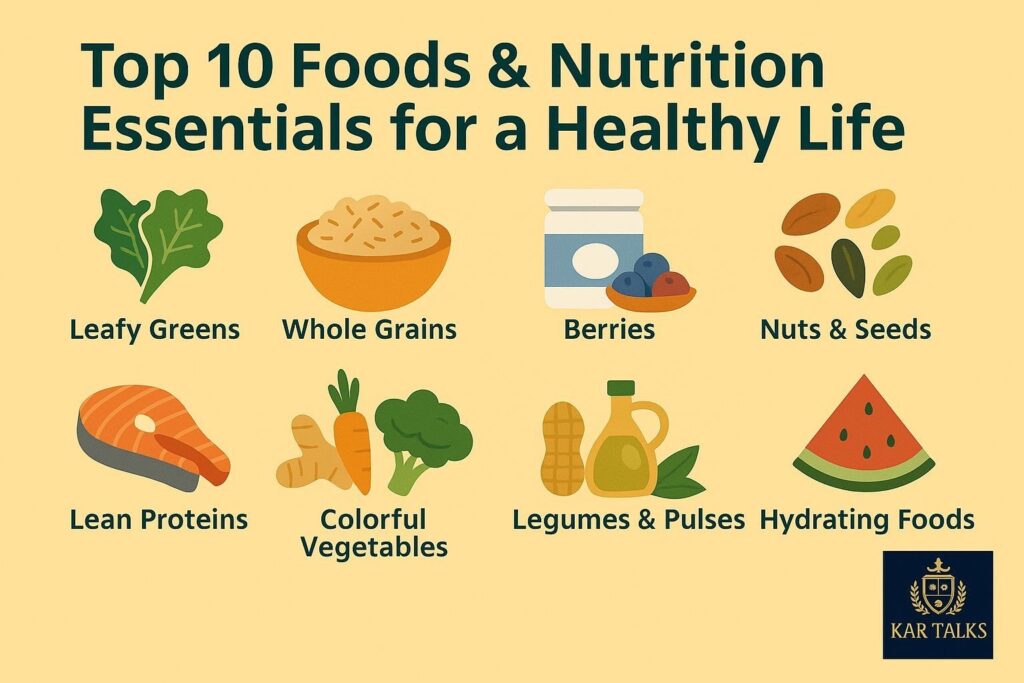
And when life gets noisy, food is often the easiest way to bring ourselves back to balance. Whether you’re trying to improve your energy, steady your mood, or simply take better care of yourself, these “Top 10 Foods & Nutrition Essentials” offer a grounded, practical path — without trends and without drama.
Let’s walk through them slowly, the way you’d flip through a Sunday wellness magazine.
1. Leafy Greens — Gentle Strength on the Plate
Leafy greens are like the quiet people who don’t speak much but always show up when you need them. Spinach softening in warm garlic, methi adding its earthy fragrance to dal, amaranth brightening a simple stir-fry — these foods have anchored Indian plates for centuries.
They’re rich in iron, vitamins, folate and plant-based minerals. But what makes greens special is how “light” they feel on the body. When you’re tired, stressed, or bloated, a bowl of greens brings a certain softness back — they digest easily, soothe inflammation, and leave you feeling clean rather than heavy.
Not every food needs to shout. Some heal quietly.
2. Whole Grains — The Slow, Steady Energy Givers
There’s something comforting about foods that release energy slowly. Oats bubbling on the stove. Bajra rotis puffing over the flame. A warm bowl of barley soup that feels like a hug from inside.
Whole grains steady your hunger and stabilize your mood. That’s why they’re recommended for people who feel sharp hunger spikes, irritability or fatigue during the day. Their fiber supports gut health; their minerals support metabolism. A large study in the American Journal of Clinical Nutrition found that people who ate whole grains regularly had better long-term heart health.
The beauty? These foods are simple, accessible, and fully in tune with how the body likes to function.
3. Berries — Small Fruits, Big Impact
Berries often look too pretty to be serious food — yet they’re among the richest sources of antioxidants on the planet. If you’ve ever eaten fresh jamun and smiled at the purple stain on your fingers, you already know berries aren’t just food; they’re mood-lifters.
Blueberries, strawberries, blackberries, gooseberries — even a small handful supports brain health, memory, and immunity. On hectic weeks, a bowl of berries can feel like nature’s way of saying, “Slow down. Look after yourself.”
They’re tiny, but they protect you in ways you don’t immediately see.
4. Yogurt & Fermented Foods — Calm for the Gut, Calm for the Mind
Walk into any Indian kitchen at lunchtime and you’ll likely find curd somewhere on the table. There’s an intuitive understanding in our culture: curd cools the body, settles the stomach, and lightens the meal.
Fermented foods — yogurt, kefir, buttermilk, idli batter, homemade pickles — nourish the gut microbiome, the mini-universe inside your stomach. Research on the gut–brain connection shows that a healthy gut supports emotional regulation and reduces anxiety. Anyone who has eaten curd rice at the end of a stressful day can confirm this without reading a single journal.
It’s comfort food with science behind it.
5. Nuts & Seeds — Tiny Nutrition Powerhouses
Nuts and seeds are the quiet achievers of the nutrition world.
Almonds in your bag.
Flaxseeds in your smoothie.
Chia seeds thickening your overnight oats.
Pumpkin seeds tossed on a salad.
These small foods deliver healthy fats, omega-3, zinc, magnesium, and protein — nutrients that support brain sharpness, hormonal health, and stable energy. People often underestimate the impact of a simple daily handful.
The trick is consistency, not quantity.
6. Lean Proteins — The Body’s Repair Crew
Protein doesn’t have a glamorous reputation, but the body relies on it more than we realize. Every time your muscles strengthen, wounds heal, hair grows, or immunity kicks in — protein is behind the scenes.
You don’t need to overthink it:
Eggs for breakfast.
Dal with lunch.
Paneer in a curry.
Fish a few times a week.
Sprouts when you want something light.
Protein stabilizes appetite and prevents the energy crashes that make you crave junk food. It keeps the body functioning with quiet reliability.
7. Colorful Vegetables — The Rainbow That Heals
A colorful plate is a happy plate.
Red tomatoes bursting with lycopene.
Orange carrots crisp with beta-carotene.
Green beans full of minerals.
Purple beetroot humming with antioxidants.
White garlic with its natural anti-bacterial strength.
Each color plays its own part. Something magical happens when you eat a rainbow — your nutrient intake broadens, your immunity improves, and your meals feel more alive.
A colorful plate feels joyful before it feels healthy.
8. Legumes & Pulses — The Heart of Everyday Indian Nourishment
Dal is not just food.
Dal is childhood.
Dal is comfort.
Dal is home.
Rajma on a rainy afternoon.
Chole on a Sunday.
Moong dal khichdi when you’re unwell.
These meals are protein-rich, fiber-rich and incredibly affordable. They regulate blood sugar, protect the heart, and satisfy hunger far better than many processed foods. For vegetarians especially, legumes are essential.
They prove that nutrition doesn’t need to be complicated to be powerful.
9. Healthy Oils — The Fats That Support You
Oil is often misunderstood — people label it “good” or “bad” without nuance. But the truth is simpler: the right oils in the right amount support brain health, hormones, and digestion.
Mustard oil for its sharp warmth.
Olive oil for salads and light cooking.
Groundnut oil for stability.
Coconut oil for traditional South Indian dishes.
The key:
Use good oil.
Use little oil.
Avoid re-using fried oil.
Your body knows the difference.
10. Hydrating Foods — Your Inner Cooling System
Most people don’t realize how often their body is dehydrated until a headache or fatigue hits. Hydrating foods are your safety net:
Coconut water on a hot afternoon.
Cucumber in your salad.
Watermelon cooling the tongue.
Buttermilk after a heavy lunch.
Soups in the evening.
Hydration improves concentration, digestion, skin, mood — almost everything. It’s the simplest habit and yet the one we forget the most.
A Plate That Actually Works
When you start combining these foods, a natural balance appears:
A spoon of dal.
A handful of nuts.
A portion of whole grains.
Half a plate of vegetables.
Something fermented.
Something hydrating.
This plate doesn’t feel restrictive — it feels alive. It supports your day rather than controls it.
A Soft Reminder for the End
Food is not only what keeps you alive — it’s what keeps you connected.
To culture.
To memory.
To care.
Good nutrition is not built in one big decision, but in a hundred small quiet choices.
A fruit instead of a packet snack.
A glass of water before coffee.
A bowl of dal when you need grounding.
A handful of nuts during a busy afternoon.
These little choices shape your long-term well-being more than any diet ever could.
Wellness grows softly.
You just have to give it a place at your table.