
🏭 Hindalco Industries – Metals play with a cleaner balance sheet
Hindalco’s latest Q2 FY26 numbers were solid for a cyclical metal stock.
Consolidated revenue came in around ₹66,000+ crore, up roughly 13% year-on-year, and PAT was about ₹4,741 crore, up close to 21% YoY. The growth was driven by the core India aluminium & copper business and stable performance from Novelis, its global downstream unit that now contributes a major chunk of the top line.
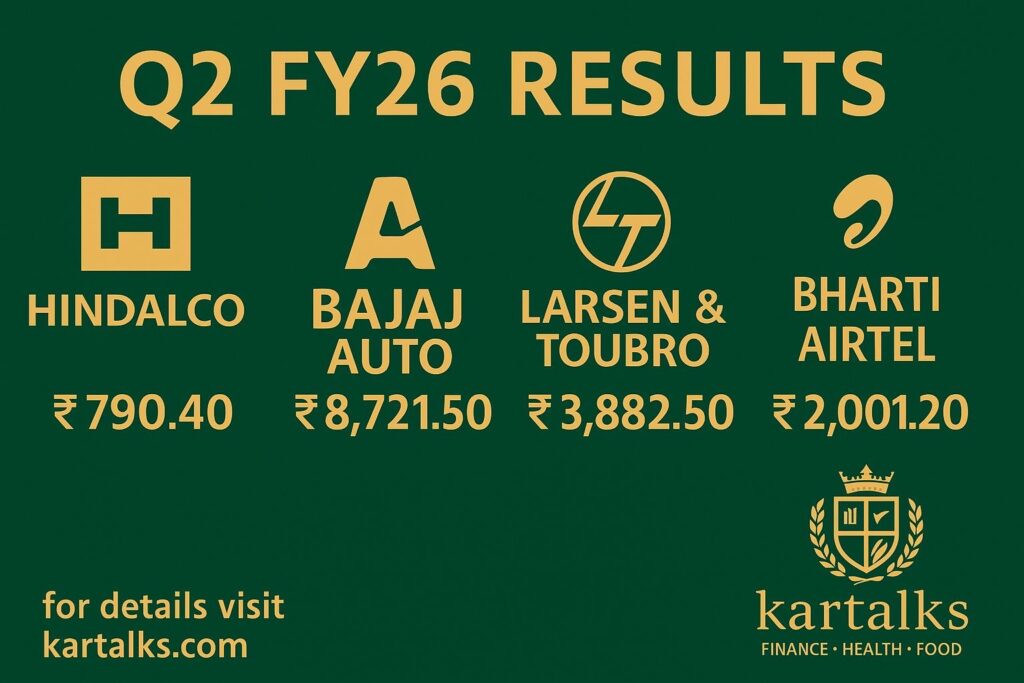
On the market side, Hindalco’s share price is hovering near ₹790, with a 52-week range of roughly ₹546–₹864. At these levels the stock trades at about 10–11x earnings and ~1.4x book, which is reasonable for a large, diversified metals player – not “dirt cheap”, but nowhere near bubble territory either.
Promoter holding sits around 34–35%, FIIs own close to 30%, and the debt-to-equity ratio has come down to roughly 0.5x on a consolidated basis – much healthier than older cycles when metals often ran with heavy leverage.
Technically, Hindalco is trading in the upper half of its yearly range. On many traders’ charts, ₹760–740 tends to act as the first support pocket, with a deeper cushion closer to ₹710–700. On the upside, the supply zone usually shows up around ₹820–840, and then near the old high zone around ₹860–870.
How a lot of market participants look at it:
- For short-term traders, it behaves like a typical metal stock – great for swings, not for sleepy portfolios. They often look to buy closer to support and avoid chasing near the upper band.
- For medium-term investors, Hindalco is more of a “cycle + structural” metals story – decent Q2 growth, better balance sheet, but still linked to aluminium prices, China, tariffs and global demand.
🏍️ Bajaj Auto – High-quality auto with record numbers
Bajaj Auto’s Q2 FY26 was one of those quarters management likes to frame.
The company delivered record revenue of around ₹14,900–₹15,000 crore, up roughly 14–19% YoY, and PAT of about ₹2,480 crore, up 24% YoY. EBITDA crossed ₹3,000 crore for the first time, helped by a richer product mix (premium bikes, exports, 3-wheelers) and reasonably stable margins.
On the screen, Bajaj Auto trades around ₹8,700+, with a 52-week range near ₹7,100–₹10,000. At these prices it commands a PE of ~29x, PB of ~7x, and ROE north of 22% with ROCE close to 28% – classic high-quality auto metrics, priced like a market leader.
Promoter holding is high, around 55%, and the balance sheet is almost debt-free – some databases show debt-to-equity effectively near 0.0–0.25x, which is negligible for a company of this size.
On the charts, Bajaj Auto has already had a big run. Traders generally treat ₹8,400–8,200 as the first demand zone and ₹7,900–7,700 as a deeper support area. Resistance is seen around ₹9,000–9,200, and again near that psychological ₹9,700–10,000 band where it made its highs.
How people usually position it:
- Long-term investors see Bajaj Auto as a core 2-wheeler / 3-wheeler + export franchise, with steady cash flows and optionality from EVs and premiumisation.
- Because it’s not cheap on valuations, many prefer staggered entries or SIP-style buying rather than an all-in entry at the top of the range.
- Short-term traders look for pullbacks to support with tight stops; chasing breakouts on a 29x PE stock is usually reserved for high-conviction momentum traders.
🏗️ Larsen & Toubro (L&T) – Big infra engine with huge order book
Now to infra. L&T’s Q2 FY26 numbers show why it’s treated as a proxy for India’s capex story.
Revenue from operations came in around ₹67,984 crore, up a bit over 10% YoY, and net profit was roughly ₹3,926 crore, a growth of around 15–16% YoY. The headline number, though, was order inflow of around ₹1.15 lakh crore in the quarter, up more than 40% YoY, and a total order book of about ₹6.67 lakh crore, giving the company multi-year revenue visibility.
The stock trades near ₹3,880 per share, with a 52-week range of roughly ₹2,965–₹4,063. At this band, L&T is valued at about 33x earnings and ~4.6x book, with ROE in the mid-teens and ROCE in the low-to-mid-teens, which is respectable for a project-heavy engineering and construction conglomerate.
There is no dominant promoter; L&T is professionally managed with effectively 0% promoter holding and a widely held shareholding pattern, including FIIs, DIIs and retail. Debt is moderate for its size – debt-to-equity near 0.3x in recent data.
Technically, price is consolidating just below the 52-week high. Many traders mark ₹3,750–3,700 as the near support pocket and look at ₹3,500–3,450 as a more attractive accumulation zone if the market corrects. On the upside, the band near ₹3,950–4,050 remains the resistance area – a clean breakout there would be a fresh all-time high.
How investors frame L&T:
- Often treated as a core infra / capital-expenditure holding for long-term portfolios.
- Q2 FY26 confirms the story: profit growth, revenue growth, and a very large order book across infra, energy, defence and international projects.
- Main risks are execution, working capital and global macro, not the quality of the franchise itself.
📡 Bharti Airtel – ARPU up, debt slowly coming down
Bharti Airtel’s Q2 FY26 is all about scale and operating leverage.
Consolidated revenue was around ₹52,145 crore, up roughly 25–26% YoY, with India revenue near ₹38,690 crore, up about 22–23% YoY. EBITDA came in close to ₹29,900 crore with an EBITDA margin of ~57.4%, and net profit jumped sharply YoY to around the ₹6,800 crore mark (exact figure varies slightly by one-off adjustments in different data sets).
Most importantly for telecom, ARPU is hovering around ₹250+, the highest in the industry, and many street models now build in a further ARPU step-up over the next year or two as tariff discipline holds.
On price, Bharti Airtel trades around ₹2,000, with a 52-week range of roughly ₹1,511–₹2,135. The stock is valued at 30–32x earnings on recent numbers – again, not a bargain basement multiple, but the market is paying up for earnings visibility and strong cash flows.
Promoter holding is just over 50%, FIIs hold about 27%, and DIIs close to 19%, showing broad institutional ownership. Debt is still meaningful – consolidated debt-to-equity is roughly in the 1.3x zone, but the trend is downward as free cash flow improves and capex on 5G rollout gradually normalises.
From a technical angle, traders usually keep an eye on ₹1,950–1,900 as the first support band and ₹1,820–1,800 as the deeper comfort zone. On the upside, the recent high area near ₹2,130–2,150 is the main resistance: above that, the stock can try to build a new leg of the uptrend; below support, it tends to consolidate or correct a bit more.
How Bharti fits in portfolios:
- It’s a direct play on data usage, 4G/5G penetration, post-paid, enterprise and digital services.
- Fans of the stock like the combination of high ARPU, improving margins and gradual deleveraging.
- Risks come from regulation, spectrum policy, AGR legacy issues and debt, so it’s more of an anchor telecom bet for patient investors, not a “no-risk” idea.
Read further👇
BEL, Persistent, Latent View, Chennai Petroleum, Sai Silks (Kalamandir)
Stock Market 101: Learn Stocks from Zero
⚠️ Disclaimer:
This discussion is meant only for education and general information.
It is not investment advice, not a SEBI-registered research report, and not a recommendation to buy, sell or hold Hindalco Industries, Bajaj Auto, Larsen & Toubro or Bharti Airtel.
All prices, levels and ratios are approximate and can change.
Please consult a SEBI-registered investment adviser before making any investment or trading decisions.
Investing and trading in securities involve risk of loss of capital.