
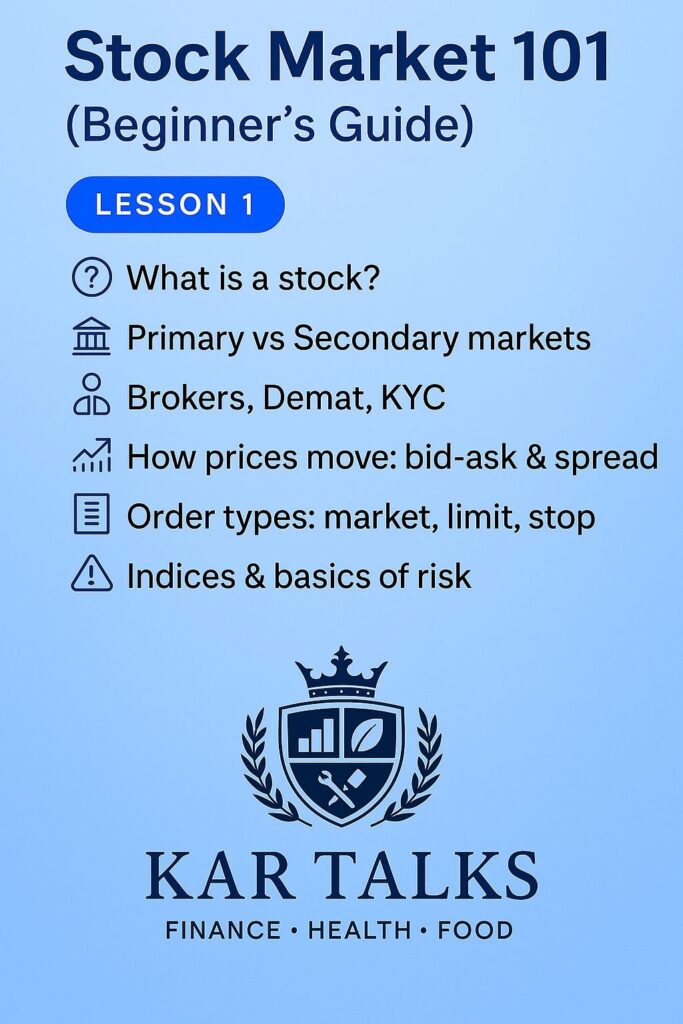
Stock Market 101- a weekly beginner series by kartalks
Hook
If the words “stocks,” “brokers,” or “exchanges” sound intimidating, you’re not alone. Think of the stock market as a giant, well-organized marketplace—more like an online app than a chaotic casino. In this first lesson, we’ll go from “I have no clue” to “I get the big picture.
Key takeaways
- A stock is a tiny slice of a company.
- Companies raise money in the primary market (IPO); most everyday trading happens in the secondary market.
- You access markets through a broker; trades are matched on an exchange.
- Prices move because of supply and demand, visible in the bid–ask.
- Start with education and practice—don’t risk money you can’t afford to lose.
1) What is a stock, really?
A stock (also called “equity” or “share”) is a small ownership piece of a company. If a company has 10 million shares and you own 100, you own 0.001% of the company. Ownership doesn’t mean you run the place; it means you participate in its outcomes:
- If the company grows and becomes more valuable, your shares can rise in price.
- The company may share profits via dividends (not guaranteed).
- If the company struggles, share prices can fall—or in extreme cases go to zero.
Plain analogy: Imagine a pizza cut into slices. The pizza is the company; each slice is a share. If the pizza gets more popular (better brand, more stores, more profit), each slice becomes more valuable.
2) Why do companies “go public”?
Companies need money to expand—hire people, build factories, open stores, invest in technology. They can:
- Borrow money (loans/bonds), or
- Sell ownership (shares) to the public.
The first time a company sells shares to the public is called an IPO (Initial Public Offering). That happens in the primary market. After the IPO, the shares start trading every day between investors in the secondary market. (The company doesn’t receive money from these everyday trades; buyers and sellers exchange shares with each other.)
3) Where does trading happen? Exchanges, brokers, and your account
You don’t walk into a building to trade; you use a broker (an app/website). The broker connects you to the exchange (the organized marketplace). You place an order (e.g., “Buy 10 shares at ₹100 or lower”), your broker sends it to the exchange, and the exchange’s system matches your order with someone on the other side who wants to sell.
You’ll typically need:
- KYC/identity verification and
- A trading + demat/custody setup (a safe place to hold your shares digitally).
For official beginner education material, check your local regulator/stock exchange education pages (e.g., Investor.gov’s “Introduction to Investing” and NSE’s “Investor Education” sections).
Mini visual (text):
Company lists shares → Exchange
You ↔ Broker/App ↔ Exchange ↔ Other investors
4) How do prices move? Supply, demand, bid, ask, spread
At any second, some investors want to buy and some want to sell.
- The highest price buyers are willing to pay is the bid.
- The lowest price sellers are willing to accept is the ask.
- The gap is the spread.
If buyers become more eager (good news, strong results), they’ll bid higher—price tends to rise. If sellers rush to exit (bad news, disappointment), they accept lower prices—price tends to fall. That constant push-pull is how price discovery works.
Example:
- Best bid: ₹99.90 for 500 shares
- Best ask: ₹100.10 for 400 shares
If you place a market buy for 200 shares, you’ll likely get filled at ₹100.10 (the current ask). If you place a limit buy at ₹100.00, you’ll wait in line until a seller agrees.
5) Order types (just enough for day one)
- Market order: “Get me in/out now at the best available price.” Fast, but you may pay the spread.
- Limit order: “Only buy at ₹X or lower / sell at ₹Y or higher.” More control; might not fill.
- Stop/Stop-loss: A trigger that turns into a market/limit order to help manage downside.
We’ll dive deep into order types and execution in a later lesson. For now, know that limit orders give you price control, market orders give you speed.
6) Indices: the market’s scoreboard
You’ll hear about indices (Nifty, Sensex, S&P 500, etc.). An index is a curated basket of stocks used to represent a market or sector. If the index goes up, it suggests that, on average, its member companies gained value that day. Beginners often use an index to track “the market” instead of watching hundreds of tickers. See an official primer on what an index is and why it’s used.
7) Risk, returns, and time
All investing involves risk. Prices can swing daily; sometimes dramatically. Two truths to remember:
- Higher potential return usually comes with higher risk.
- Time in the market beats timing the market for most beginners—regular contributions and patience tend to work better than guesses.
Learning topics like asset allocation (how much to put in stocks vs bonds vs cash) helps you match risk to your goals. Here’s a plain-English resource on asset allocation for later reading.
8) Costs and taxes (don’t skip this)
Even small costs can nibble away at gains over time: brokerage fees, taxes/levies, and the spread. Know your fee schedule and local rules. Official education pages from your domestic exchange/regulator are best for the latest details. (For example, NSE’s Investor Education hub lists charges and basics for first-time investors.)
9) A worked example (numbers you can follow)
Let’s say you buy 10 shares at ₹100 each with a small brokerage fee.
- Cost basis: ₹1,000
- If the price rises to ₹112, your position value is ₹1,120.
- Unrealized gain: ₹120 (before costs/taxes).
- If you sell at ₹112, subtract fees/taxes to get your net result.
If the price falls to ₹92, your position value is ₹920; you’re down ₹80 (unrealized) unless you sell. This is why we’ll later cover position sizing and stop-losses—the most beginner-friendly risk controls.
10) Common beginner mistakes (and simple fixes)
- Starting with hot tips. Fix: Learn a basic framework first; use a checklist.
- All-in on one stock. Fix: Diversify; consider starting with broad market funds.
- Ignoring costs. Fix: Read your broker’s fee table; prefer limit orders in thinly traded names.
- Confusing trading with investing. Fix: Decide your time horizon before buying.
- Using emergency funds to trade. Fix: Keep an emergency buffer separate from investing.
11) Mini-FAQ (beginner edition)
Is the stock market gambling?
No—if you treat it as investing in real businesses, use diversification, and have a plan. It can feel like gambling if you chase tips and short-term hype.
How much money do I need to start?
Often, not much—brokers allow small purchases. But first build an emergency fund and learn the mechanics.
What’s a dividend?
A portion of profits a company may distribute to shareholders. Not guaranteed.
Can I lose all my money?
If a company fails, a stock can go to zero. Diversification and risk controls help reduce the odds of a catastrophic outcome.
What should I learn next?
Start with assets 101 (stocks vs bonds vs ETFs vs mutual funds) to understand your choices.
12) 5-question quick quiz
- The first time a company sells shares to the public is called:
A) Split B) Buyback C) IPO D) Dividend - The bid–ask spread is:
A) Broker’s profit
B) Difference between best buyer and best seller price
C) Government tax
D) Company revenue - A limit order lets you:
A) Avoid all risk
B) Set your maximum buy or minimum sell price
C) Skip fees
D) Get instant execution at any price - An exchange is:
A) A personal finance app
B) A regulated marketplace that matches buy and sell orders
C) A social network
D) A savings account - An index is:
A) A random list of stocks
B) A bond portfolio
C) A basket of selected stocks used to represent a market/sector
D) Company profit
(Answers: 1-C, 2-B, 3-B, 4-B, 5-C)
13) Action checklist (copy into your notes)
- ✅ Read this lesson twice and write down any words you still don’t fully get.
- ✅ Create a paper trading practice account (most brokers offer it) and place two test orders: one market, one limit.
- ✅ Note every fee in your broker’s tariff page; keep a one-page summary.
- ✅ Shortlist 1–2 broad market indices you’ll follow.
- ✅ Block 30 minutes on your calendar for Lesson 2 next week.
14) Further learning (official, beginner-friendly)
- Investor.gov – Introduction to Investing (US SEC; plain English basics).
- NSE India – Investor Education / Getting Started (account opening, charges, awareness) NSE
- BSE – Booklet on Securities Market (concepts: primary/secondary markets, basics). BSE
- Investor.gov – Investment Products overview (stocks, bonds, mutual funds, ETFs).
Important note (trust & compliance)
This series is educational and not financial advice. Markets and tax rules change—always check current, official sources (your local regulator/exchange) before acting.
Very Informative
Thank you