
🕒 Introduction
In the past decade, healthcare has evolved far beyond hospitals and clinics. Thanks to wearable devices, mobile apps, and AI-driven analytics, individuals are taking charge of their health in unprecedented ways.
This movement, often referred to as DIY Digital Health, represents a fusion of technology, personal empowerment, and modern medicine.
In this article, we’ll explore the current trends, benefits, challenges, and future opportunities of this health revolution.
⌚ State of Wearable Health Tech Today
🧭 From Fitness to Medical-Grade
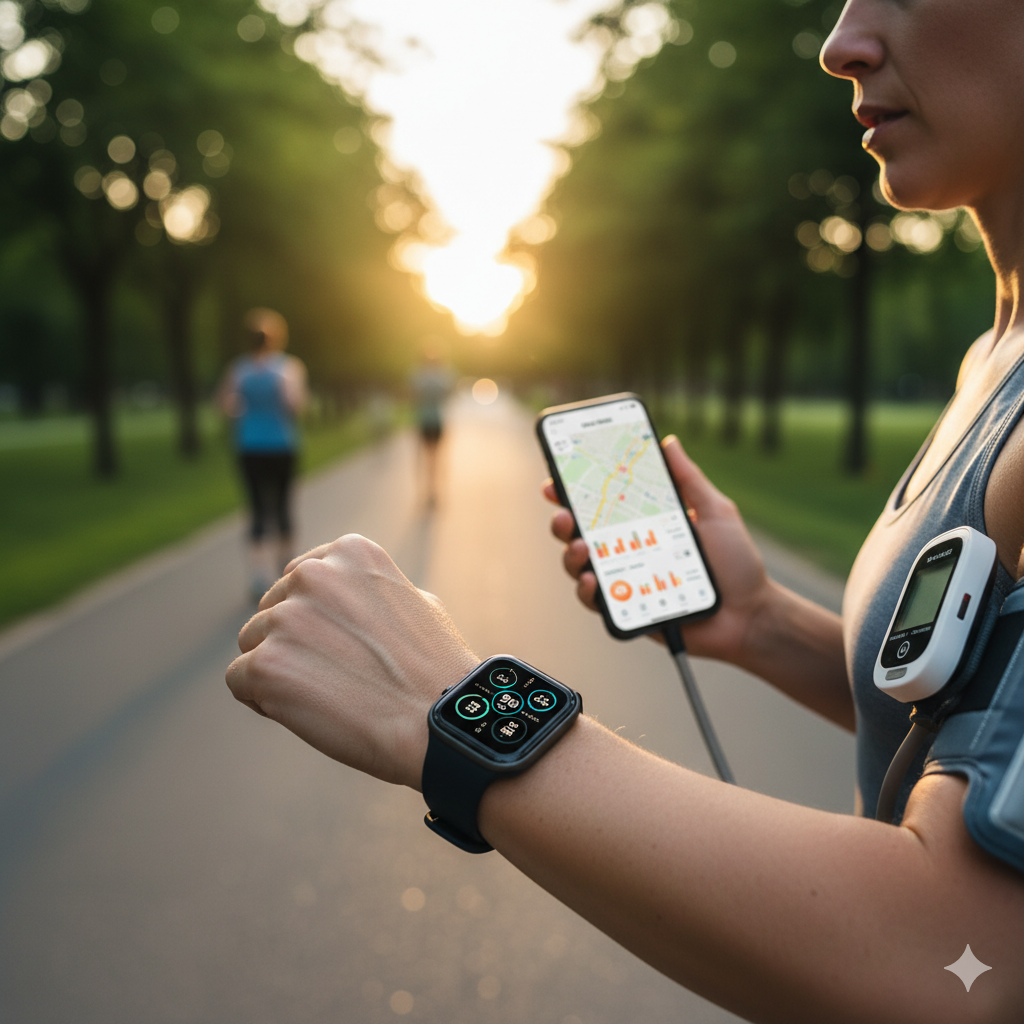
Wearables started as fitness trackers counting steps and calories. Modern devices can now monitor:
- Heart rate & variability
- Oxygen saturation (SpO₂)
- ECG & arrhythmia detection
- Skin temperature
- Respiratory rates
These metrics have clinical significance, making wearables essential tools for both personal wellness and medical research.
☁ Convergence with AI & Cloud
Data collected by wearables is analyzed in real time by AI algorithms, often through cloud platforms. This enables:
- Pattern recognition (e.g., irregular heartbeat detection)
- Personalized insights
- Remote health monitoring by physicians
📎 Example: Apple Watch’s irregular rhythm notification has been used to detect atrial fibrillation in large population studies.
🤖 Why AI & Data Matter — Turning Signals into Insight
🧪 The Data Pipeline
- Sensing – collecting physiological data via sensors
- Pre-processing – filtering noise and normalizing signals
- Feature extraction – computing key health indicators
- AI modeling – detecting anomalies, trends, predictions
- User feedback – presenting results through dashboards, alerts, or health reports
⚠ AI Challenges
- Generalization across populations
- Privacy and security of sensitive data
- Model explainability for trust
- Data storage & transmission costs
🌱 Benefits & Opportunities of DIY Digital Health
🩹 Early Detection & Prevention
Wearables can detect subtle changes (e.g., elevated resting HR, reduced sleep quality) that may indicate illness onset days earlier than symptoms appear.
👤 Personalized Health Insights
Users can visualize how sleep, diet, stress, and exercise impact their body metrics. This encourages healthier daily choices.
🏥Better Chronic Disease Management
For conditions like diabetes, hypertension, or COPD, wearables provide continuous monitoring, enabling timely interventions and better outcomes.
🌍 Democratizing Access
In remote or low-resource settings, wearable devices can provide basic health diagnostics where hospitals are inaccessible.
📊Research & Population Health
Massive datasets collected passively from wearables can advance epidemiology, detect outbreaks, and improve healthcare planning.
🚧Challenges, Risks & Ethical Concerns
🎯 Accuracy & Validation
Different skin tones, body types, or movement can affect sensor readings. Not all wearables are clinically validated, raising concerns about data reliability.
😰 Overdiagnosis & Alarm Fatigue
Frequent false positives can lead users to panic unnecessarily or ignore alerts over time.
🔐 Privacy & Data Ownership
Who owns the data — the user, device company, or healthcare provider? Misuse or breaches can have serious consequences.
⚖ Equity & Accessibility
Devices may not work equally well for all populations, potentially widening health disparities.
🚀 Future Outlook & What to Build Next
🧬 Emerging Trends
- Hybrid devices (wearable + implantable) for better biomarker accuracy
- Multimodal sensing to combine heart, sweat, movement & temperature data
- On-device AI for faster, privacy-preserving processing
- Federated learning to train models without sharing raw data
- Digital twins — virtual physiological replicas for predictive healthcare
💡 Opportunities for Developers & Designers
- Insight dashboards for wearable data
- Explainable AI modules for trust-building
- Lightweight apps for low-resource settings
- Privacy & compliance auditing tools
- Health literacy UX elements for better user understanding
📝 Conclusion
DIY Digital Health is reshaping modern medicine by merging wearable technology, data analytics, and personal agency.
This transformation enables early detection, personalized insights, chronic disease management, and democratized healthcare access. But success depends on solving challenges around accuracy, privacy, equity, and regulation.
For innovators, this field offers a rich landscape to build tools that are not only technically advanced but also ethically responsible a
🥗 Beetroot Cutlets (High-Fibre, Iron-Rich & Perfect for Evening Snack)